Zoho’s Quiet Enterprise Coup: A Unified Platform Built for the AI Era
Zoho has quietly built a global footprint that most tech leaders underestimate. It isn't midmarket anymore, operating in 150+ countries, serving over a million businesses, and supporting 150 million users. Zoho’s partner-led go-to-market strategy has led to its widescale adoption across industries, including manufacturers, automotive franchises, banks, logistics networks, and healthcare systems.

Source: Zoho Analyst Relations
What Zoho Just Announced (February 2026)
Note: Some of these are available now; others are roadmap commitments for later in 2026.
Source: Zoho Analyst Relations
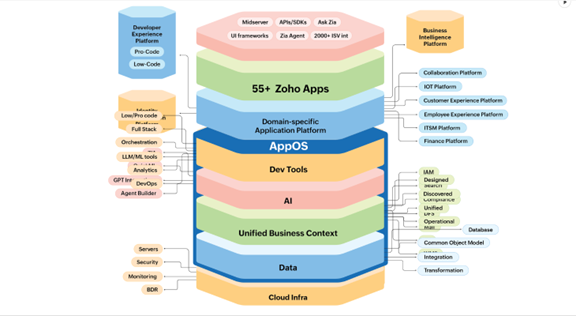
1. AppOS: Tackling SaaS Fragmentation at the Architecture Level
The core problem that AppOS is solving: In an enterprise running hundreds of SaaS solutions and tools, each with its own data model, permission structure, and API quirks. Integration becomes a permanent tax, data consistency is a constant fight, and compliance audits become painful because you can't trace a transaction across systems.
AppOS isn't another integration layer. It's a platform designed so that business context, workflows, and permissions are defined once at the core. Applications inherit alignment instead of requiring custom wiring. This is a meaningful shift from how SaaS vendors typically approach the problem.
Why this matters to you: If you're managing heavy application sprawl, unclear data lineage, or fragmented workflows, this is worth evaluating. The payoff is lower integration overhead and a cleaner foundation for AI-driven automation.
2. Rethinking Finance Ops: One Platform for Payments, Compliance, and Banking
Zoho detailed its broader finance and operations strategy, highlighting new capabilities across payments, cards, spend controls, know your customer (KYC), reconciliation, settlements, transaction monitoring, POS devices, and partnerships for lending. It described rapid adoption in India, ongoing expansion into other markets, and strong interest from customers moving away from legacy payment systems. Zoho also emphasized how emerging digital public infrastructure in developing economies, such as India’s UPI, is reshaping financial ecosystems, and how Zoho is aligning its products with these national platforms.
Zoho approaches finance and operations as an interconnected system spanning three areas: fintech, banking, and financial workflows. On the fintech side, Zoho has built modules for payments, KYC/ID verification, reconciliation, settlements, POS hardware, and lending use cases like invoice financing and working‑capital loans in partnership with banks. On the banking side, Zoho connects directly to banks so customers can pull transactions, reconcile accounts, make vendor payments, and use banking services without legacy, host‑to‑host setups. Across these layers, Zoho embeds compliance for taxes, regulations, and privacy, plus tools for AI‑based anomaly detection, reporting, and insights.
Why this matters to you: Finance operations are becoming more complex as regulations shift, digital payment volumes surge, and global supply chains fluctuate. Zoho’s unified approach reduces the need for multiple disconnected fintech tools, custom bank integrations, and manual reconciliation. IT leaders gain a single platform designed to automate financial flows, support regulatory changes, integrate modern payment infrastructure, and reduce operational overhead. This approach enables organizations to move faster, maintain compliance, and adapt to new financial realities without building or maintaining complex integrations themselves.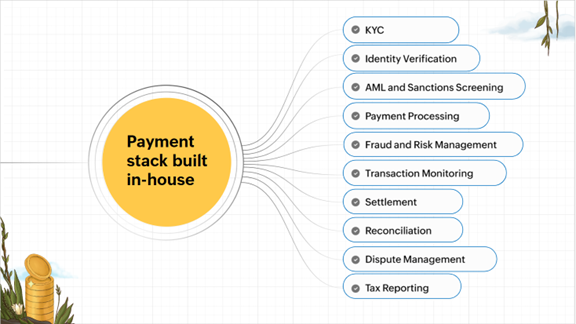
Source: Zoho Analyst Relations
3. Unified ERP
Midmarket ERPs have to move beyond limited compliance capabilities or undergo a complicated, multiyear implementation. Zoho's ERP is built around compliance and validation from the ground up, audit trails, statutory requirements, localized payroll, and regulatory logic baked into the core.
It’s rolling out vertical versions through 2026 (financial services, healthcare, field services, etc.), each with domain-specific rules and workflows preconfigured.
Why this matters to you: You get an ERP that is operationally complete for regulated environments without the cost, risk, and timeline associated with traditional ERP implementations. For compliance‑driven organizations, this significantly lowers implementation risk and long‑term consulting spend.
4. Vertical Industry Solutions
Instead of shipping generic templates with “industry flavor,” Zoho is embedding actual domain logic at the platform level, scheduling systems, pricing models, validation rules, and compliance requirements specific to financial services, healthcare, field operations, etc.
This goes beyond surface-level customization. It means an organization in residential services gets workflows and data structures that reflect how that business operates, not a generic system that needs heavy configuration.
Why this matters to you: Industries with complex compliance or operational requirements typically pay for custom development or expensive vertical systems. Having this built into the platform reduces both timeline and cost.
5. Enterprise Data & Analytics Platform
Zoho launched a data platform designed to unify data across systems, enforce governance, and provide a foundation for analytics and AI. It's addressing a real blocker: many enterprises discover that their constraint on AI deployment isn't the LLM – it's fragmented, low-trust data.
The platform includes hybrid connectivity (important if you still have on-prem systems), vertical, ready data structures, and built-in governance.
Open questions that stand out at the moment:
- How will operational vs. analytical data challenges be addressed?
- Master data is core to data integration and unified data repository – how is it going to be enabled?
- What is the mechanism for easy integration of application- and BU-specific data models?
Several important questions remain open at this stage. First, how can organizations effectively tackle the challenges of operational vs. analytical data? Second, since master data is fundamental to data integration and establishing a unified repository, what approaches will be used to support this? Finally, what strategies are in place to ensure seamless integration of application- and BU-specific data models?
Why this matters to you: If implemented properly, better data infrastructure directly enables better automation, forecasting, and compliance monitoring. It reduces the need for separate data engineering projects.
6. Zoho + ManageEngine Integration
Most SaaS platforms stop at business functions. ManageEngine covers IT operations, identity, device management, compliance, asset tracking, and operational telemetry. Zoho is integrating these so that your IT governance and business workflows share the same policy framework. ManageEngine is a division of Zoho.
This means device posture can influence workflow permissions. Identity can be tied to financial controls, and you have a single audit trail across business and IT.
Why this matters to you: As you move into AI-heavy operations, the separation between business processes and IT governance becomes increasingly untenable. This integration provides a meaningful advantage for organizations that care about auditability and risk.
7. Zoho Workplace’s Big Move: Flexibility, Control, and Contextual AI
Zoho showcased major updates to Workplace, centered on large‑scale migrations from Google and Microsoft, deeper data‑sovereignty options, and a new wave of contextual AI capabilities. Zoho also highlighted strong market traction, especially in regulated sectors and governments, and introduced forthcoming upgrades to unified communications, meetings, and AI-driven workflow automation.
Workplace now supports phased coexistence with Microsoft 365 and Google Workspace, allowing organizations to move departments gradually with full interoperability across email, calendar, directory, and chat. Zoho provides free migration planning and execution for midmarket and enterprise customers and can deploy environments in public cloud, virtual private cloud, or on-prem as required. The new AI layer automatically interprets signals from email, chat, and documents to create tasks, routes, folders, and follow-ups without manual configuration
Why this matters to you: These capabilities reduce migration risk, simplify compliance, and provide alternatives to vendor lock-in at a time when licensing changes and regulatory scrutiny are accelerating. For IT leaders, Workplace offers a way to modernize collaboration without multiyear projects, preserve data sovereignty, and gain AI-driven efficiency without mandatory AI surcharges. It gives you more control over deployment, cost, and customization than traditional suites
8. The Long Game: Zoho’s Quiet Engineering Revolution
Zoho shared that it has been quietly building a lot of the “invisible” technology under its products, things like its own databases, an analytics engine that can use GPUs for speed, and even physical servers. Instead of relying on outside vendors for these core technologies, Zoho is building and tuning them itself so it can control cost, performance, and reliability.
Zoho Labs looks for big internal problems, like high database licensing costs, performance bottlenecks, or dependence on external vendors, and then builds long‑term solutions in‑house. This includes several types of custom databases, a faster analytics engine, and servers designed specifically for Zoho’s workloads. All of these plug into AppOS, so customers get better speed and efficiency automatically, without changing anything in their own code or workflows.
Why this matters to you: By owning more of the stack, Zoho reduces long‑term risk, avoids surprise licensing fees, and improves reliability. IT leaders get a platform that isn’t tied to hyperscaler limitations, can run on-prem or in sovereign regions, and offers faster performance without needing rewrites or major migration projects. In a time when AI is driving up infrastructure costs everywhere, Zoho’s approach helps keep costs predictable and gives organizations more control over their technology.
9. The Connected Customer Engine: Zoho’s 2026 CX Vision
Zoho explained how its CX platform is growing – more customers using CRM, desk, and marketing tools; more use cases from midmarket and enterprise; and steady expansion across multiple countries. The company said it is working to bring all CX products closer together by unifying data, integrations, and applications. It also showed new AI capabilities: small and task‑specific AI models, customer‑journey mapping, and Zia agents that can automate sales tasks, support workflows, and internal operations. The team ended with a preview of the 2026 direction, which focuses on unified CX, emotional intelligence, and AI‑assisted execution.
Zoho described the platform in three unified layers:
- Data (using AppOS and Zoho’s shared data model)
- Middleware (using Control Bridge to integrate cloud and on-prem systems)
- Applications (CRM, desk, campaigns, marketing automation, OneBar, etc.)
On top of that, Zoho is adding AI that can read customer sentiment, connect signals across the system, and automate the next steps. Zia agents can already help with support triage, lead qualification, call transcription and summarization, translations, and coaching. These agents include controls like traceability, guardrails, and observability.
Why this matters to you: CX unification has been an industry goal for decades, but most platforms still rely on integration rather than true convergence. Zoho’s approach is notable because it pushes unification down into the platform layer, aligning data, identity, and workflow orchestration before applications are deployed. This creates a more practical foundation for AI‑assisted CX execution, reduces fragmentation, and lowers the operational cost of managing customer‑facing systems at scale.
ZohoDay featured customers from various industries, including these examples.
Manufacturing: A legacy ERP environment with siloed data, manual compliance checks, and constant distributor reentry of data. By automating order capture with embedded validation and layering a modern interface on top, the company eliminated disruption while improving efficiency. No rip and replace.
E-commerce: Fragmented visibility into vendor payments and repetitive authentication steps. The platform enabled centralized payment tracking, end-to-end automation, and upstream bank validation, measurably reducing operational risk.
Financial Services: A customer with uptime, governance, and compliance standards exceeding typical midmarket expectations. This shows Zoho's platform has proven reliability for mission-critical environments.
The pattern: rapid pilot value, clear friction reduction, and modernization without full-stack disruption.
Impact of the New Zoho Announcements for Enterprise
- Unified architecture: Reduces integration overhead and enables automation at scale.
- Compliance as a feature, not a project: For regulated industries, this is substantial. You're not funding a three-year compliance implementation.
- Industry depth without legacy ERP pricing: You get vertical capabilities without the cost structure that made traditional ERP verticalization so expensive.
- Low-friction adoption: Start with one workflow, measure ROI, and expand. This aligns with how enterprises actually buy today, not how they did ten years ago.
- IT and business governance in one fabric: This is increasingly important as AI and automation expand beyond departmental boundaries.
Zoho’s Differentiation
- Full-stack control: Apps, data fabric, orchestration, identity, and AI all built natively under one roof. Few vendors do this.
- Vertical depth without vertical pricing: Industry logic is embedded in the platform, not sold as a $1-million-per-vertical tax.
- ManageEngine as the wedge: Most SaaS platforms lack IT operations credibility. Zoho already has it, which matters for enterprises concerned about governance and compliance.
- Land-and-expand that actually works: A realistic, measured approach to adoption that matches current enterprise procurement.
Our Take
Zoho is becoming strategically coherent in ways that are genuinely difficult to pull off. AppOS is a serious architectural attempt to solve SaaS fragmentation, not another integration tooling layer. The unified ERP and vertical modules show ambition typically reserved for legacy players. And ManageEngine gives them credibility in governance-heavy, mission-critical environments.
If you're evaluating platform consolidation, ERP alternatives, or building an AI-ready infrastructure, Zoho belongs on your shortlist.
The real competitive question isn't whether Zoho can scale – they've already proven that globally. The question is whether your organization is ready to move away from platforms that deliver less value at higher cost.
What matters now is that Zoho is no longer just a catalog of applications. They're announcing a platform strategy that brings them into the league of enterprise platforms.
Want to Know More?
- Zoho Focuses on Its Enterprise-Ready Evolution at ZohoDay 2025
- Zoho: Simplifying Enterprise Security Through a Unified Approach
- Zoho Joins Major AI Players by Launching Zia LLM, Providing a Competitive Advantage to Zoho Customers
- Sridhar Vembu (Zoho) on the Transformative Potential of AI in Software Development